
Table of Contents
Security teams processes hundreds of alerts each day, investigate suspicious activity, and work to remain just ahead of the cyber criminals. The difficulty lies in the fact that reviewing every single one of them is simply not feasible.
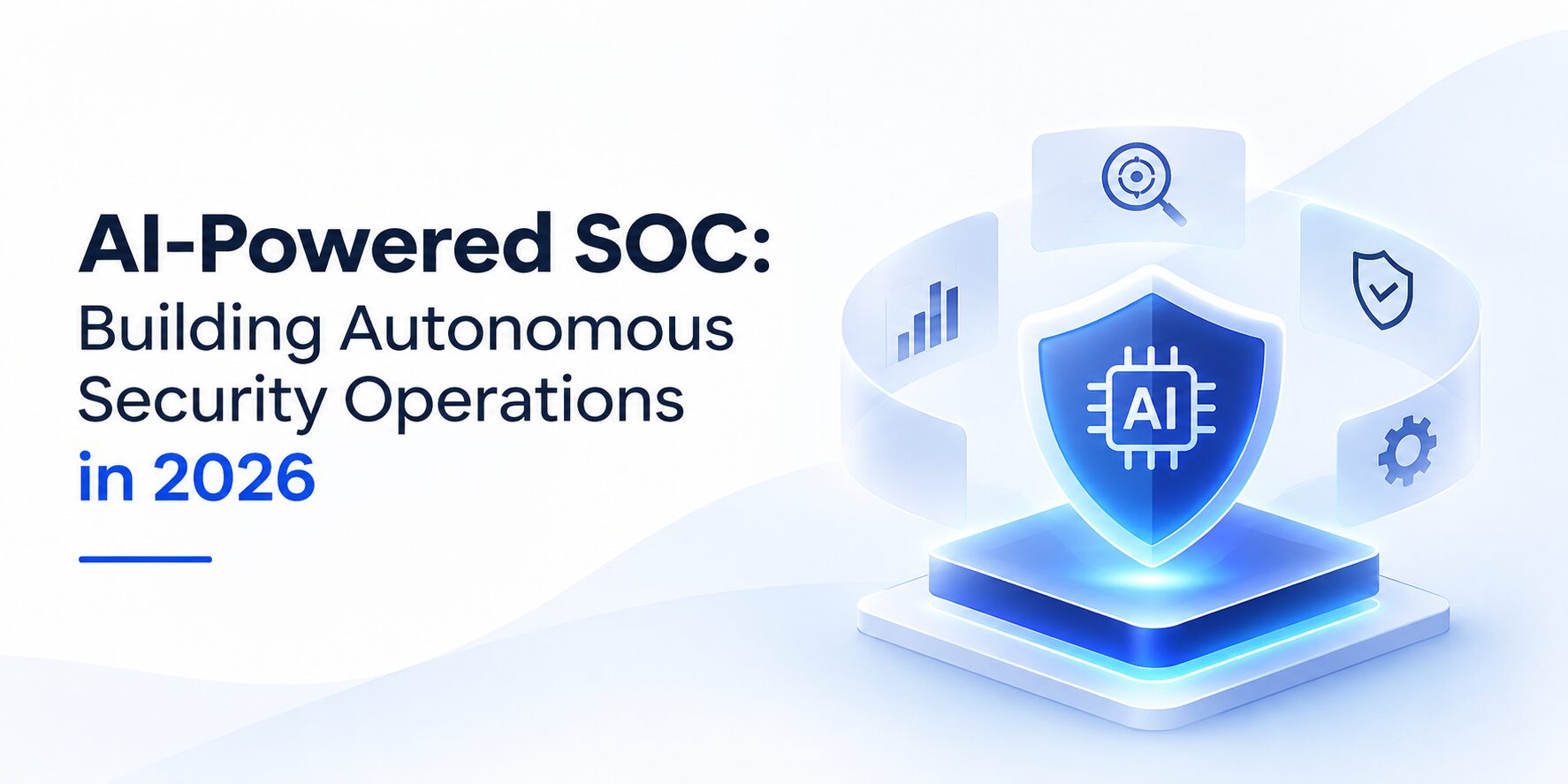
We find in 2026, AI is beginning to be embedded into the day to day operation of security teams. From investigating alerts, correlating suspicious activity, and automating some of the simpler tasks that don’t require an analyst, without having to do all of the manual work. However, integrating AI into your SOC isn’t just a matter of buying something new and flipping it on. Your teams must still identify which tasks can be automated, where human oversight is necessary, and how to address errors made by AI. This article explores how autonomous SOCs function in real-world environments, the goals they aim to achieve, and the challenges organizations face when implementing them. One thing is becoming increasingly clear: creating an autonomous SOC is about more than just technology. You need to adjust your team’s operations, decision-making processes and handling of risk.
The SOC Was Already in Trouble
However, before diving into how AI is about to make its mark on security operations, let’s take a look at the challenges that have been plaguing SOC teams for some time now.
As for example, a typical SOC gets alerted by firewalls, endpoint security solutions, identity solutions, cloud sources and a variety of other systems. A portion of these alerts indicate genuine security threats. Others are generated by normal user activity or regular maintenance or events that are benign.
The main difficulty lies in identifying which signals truly matter.
Consider a typical scenario: a security analyst starts their shift with hundreds of alerts waiting to be reviewed and investigated. As they analyze one suspicious login, dozens more pop up. Some will relate to the same event, but others will require their own follow-up. Keeping on top of it all gets very overwhelming, especially with a low team count.
And here’s where the trouble begins. Analysts wade through logs all day long, look up IP addresses, monitor endpoint activity, and file detailed reports. These are important steps, but as they repeat the entire process more and more, the process can drain the analyst’s energy, potentially leading to alert fatigue and burnout.
There’s nothing to make it any easier for the attackers. Using stolen credentials, attackers could move between devices while making their actions appear like normal business operations.
One event on its own may seem insignificant; however, several small events in context can paint a very different picture.
Let’s say that an odd login might not seem alarming by itself. But watch if that account suddenly begins opening up sensitive documents and raising permissions you need to be worried. An analyst needs to connect the dots first in order to see if an attack is happening.
SOC requires analysts, processes, and retention. Companies don’t always have the bandwidth to recruit even when they are having difficulty filling their cybersecurity positions.
AI didn’t suddenly arrive on the scene to fix a problem that, up to now, didn’t really exist. It arrived in a reality in which security teams were already searching for a way to reduce their workload.
It’s been a slow evolution. At first, SIEM systems added more sophisticated analytics and SOAR solutions brought automation to response workflows. Then, machine learning emerged, highlighting anomalies in data related to security.
These technologies proved helpful, but they didn’t eliminate the human element. Analysts continued to have to look into alerts, review the evidence, and determine what to do.
The difference today is the level of autonomy we will allow these systems to have. For certain security processes, it is possible to gather evidence, analyze an incident, and execute prescriptive response actions with little or no human intervention.
A more pragmatic question for security teams is: how much freedom should an AI system have?
In 2026, organizations are at different stages in answering this question. Some utilize AI primarily in an analyst support role; others are trialing more autonomous investigation and response. The trend is toward increasing independence and effectiveness, but the model is still evolving.
What Does "Autonomous" Actually Mean?
The term “autonomous” may imply a security system that manages all attacks unilaterally. Unfortunately, this isn’t the case of a properly developed SOC.
At the same time, even if AI is able to examine the alerts and carry out some kind of response activity, in some cases the response can never replace human decisions. An erroneous decision can lock users out of key systems, disrupt business, or can mistake a genuine process for an attack.
A more sophisticated approach is to allocate AI various degrees of autonomy based on the context.
It’s like a healthcare team. Certain basic processes can be carried out according to set protocols, but the bigger challenges need to be delegated to a specialist. You see the same analogy with security: The greater the potential impact, the more thorough the decision requires.
A feasible autonomous manufacturing SOC may be organized into three levels.
Tier 1: Complete automation
This level is appropriate when there is convincing evidence, the response is well known and the severity of any damage caused by an incorrect action is small.
For example, a phishing email that has been validated as malicious through multiple independent tests may be quarantined, searched for duplicates across other users’ mailboxes, have the attacker’s address or the malicious URL banned, and log what has been done.
The analyst does not always have to be on each step. They are following a pre-approved playbook, and the timeline records what it actually did.
The advantage is speed. If you have an attack that is running wild, can you afford the delay of someone performing each and every single task? Automating a well-coordinated response can help reduce that delay.
But automation is not meant to be triggered by just one weak indicator. An unknown IP address or a seemingly scammy email does not warrant an automatic reaction. There are specific rules that should be established to trigger an action.
Tier 2: Decisions with AI Help
Not all cases are simple. Occasionally you may have strong indications of an attack but still have some doubt. In such cases, AI can analyze the alert, gather information logs, investigate related activities, and report the results to a human analyst.
For instance, you may notice an employee has logged in from a new location and then has downloaded an anomalous amount of files. This is a red flag that their account could have been hacked, but they also could be working away from the office or on a permitted task.
For instance, rather than blocking the account without further ado, it could verify the login history, details of the device being used, access patterns, and so on, before rendering a brief report on the suspicious activity and suggested intervention. The analyst considers the conclusion and makes a decision to accept the answer suggestion.
This process minimizes the time spent collecting data, while still allowing an individual with experience to be involved in decision-making. Additionally, it allows a chance for the analyst to catch an error before it enters production. This provides many with a logical starting point for the integration of AI into SOC processes.
Tier 3 — Human-Led Investigation:
The new attack methods, threat actor signs of life, events that are close enough to crown-jewel systems, and anything else when the model’s confidence score falls below the bottom threshold. Full analyst involvement – The AI is a research assistant, not a decision-maker. Pulling logs, providing relevant threat intel, mapping to MITRE, and drafting the investigation report – analyst is in the drivers seat.
Achieving the layered security most mature teams hope for in 2026. “Remove the humans”-no, “re-deploy the humans where humans actually matter.” And that is what differentiates most deployments-failure that costs money versus success that pays off.
The Stack That Makes It Run
It’s not a product you purchase. It’s an architecture you assemble – usually from the inside out, across many vendors, and with a lot of customization and integration. Here’s what the key components actually look like:
AI-Native SIEM Legacy SIEMs were built for storage and search. New breed AI-native platforms take in telemetry and perform continuous probabilistic scoring across all events at the same time. Instead of rules that alert if X event occurs, you get models that say, a cluster of behaviors that have 94% correlation to credential stuffing, here’s the chain of evidence. One makes a huge difference in how high-quality the alert is. One makes an even greater difference in how much analyst time is needed per alert. Several platforms that come out in 2024-2025 leverage graph-based correlation engines that understand the relationships of entities in your environment, which dramatically enhances detection of multi-stage attacks that leverage those relationships.
Autonomous Investigation Engines This is the front end that evolved quite a bit in 2024-2025. Generative AI models, trained on threat intel and historical incident data, can now conduct an investigation as an experienced analyst does. Collecting and consolidating relevant logs from hundreds of data sources, verifying threat intelligence feeds, aligning findings with the MITRE ATT&CK framework, and preparing an evidence-based incident summary.What previously took an analyst forty-five minutes now produces a first draft in less than four minutes. This draft isn’t always perfect. However, it’s sufficiently good that the analyst now simply reviews and corrects it rather than creating it from scratch. A very different cognitive burden.
AI-Driven SOAR Static playbooks are being replaced by more flexible response logic. What this means is that you don’t simply take the existing flowchart and follow it, you do logic and contextual reasoning. Yes, the compromised account is the VP of Finance and this happened during business hours in a familiar travel area, not the same indicators at 2am from a very different location. That is the new thing and that is the difference between automation that helps and automation that generates its own incident through brute-force.
Threat Intelligence Synthesis AI is consuming threat intel at a volume people never can. Multiple feeds, dark web scans, vendor advisories, ISAC reports, OSINT – all being synthesized, de-duplicated, and aligned with your existing environment as it happens. So, if a threat is flagged in a feed at 6am targeting the industry vertical you operate in, your detection system is already recalibrated before your threat intel team has read their morning briefing. That ‘shift’ towards this attack was already happening thanks to AI, something no human ever could do on time.
Deception technology with AI feedback loops Honeypots and deception layers have existed for years. But AI-managed deception is something else. It automatically evolves the deception environment to lure the attacker techniques being used, gathers behavioral intelligence from attacker interactions, then drives that intelligence straight into detection logic. It’s the type of active intelligence collection that takes place 24/7, with the touch of a button – and it’s providing defenders with the very thing they have often been missing: real behavioral data about how attackers truly navigate through environments similar to theirs.
Behavioral Baseline and Drift Detection One of the lesser-noted but extremely useful used cases is AI-driven baseline drift detection. All organizations have a “normal” – normal traffic flows, normal user behaviors, normal interactions between systems. AI systems can learn and 24/7 update that baseline with a level of detail a human team couldn’t possibly maintain, and can alert you to drift that wouldn’t otherwise be seen. An employee whose data access patterns change over 3 months until they leave for a competitor. A service account that begins making slightly different API calls after a dependency update that included malicious code. These signals get missed at scale but that AI, watching everything silently, can surface.
Where It's Actually Working
Actual deployments in 2026 have real impact, and some are remarkable.
Time to Detect (MTTD) has significantly improved for those switching to the new system architectures. In a traditional network, it can take days, or even weeks, for a clever cyberattack to go unnoticed. In the new system, it’s only a matter of hours, or even minutes, before it detects odd behavior thanks to AI behavior analytics. That’s not a result of AI magic; it’s because it is monitoring everything all the time. It doesn’t get sleepy after being on the job six hours.
Time to Respond or MTTR has decreased more quickly in first level alerts. With threats blocked automatically by the system, the time from detection to initial response can be seconds. That used to be a window of opportunity for attackers to operate for hours. Now it’s disappeared. In ransomware activity – where an attack takes hours or even days to move laterally within a network before it begins to destroy, encrypt or extract data, this speed can make the difference between saving thousands of dollars or costing millions.
False positives, the security automation’s historic plague, have gotten better, but not gone away. Those “best-case” implementations have brought false positive rates to a point where automation is “feasible”-around 1-3% for Tier-1 automated actions. But “improved” does not mean “solved.” Tuning still takes extensive time and effort, and sometimes new attack methods cause a false positive spike until detection models adapt.
Organizations that have implemented AI effectively have actually experienced a rise in what is known as “analyst attrition.” When the analysts no longer waste their time clicking through hundreds of false alerts, and instead focus on actual investigations and adversary research, they’re happier. This was not apparent pre-deployment, but it’s clear now from post-deployment customer surveys. Top security talent never signed up to be a second filter for a plethora of false positives in a SIEM. They entered for the intellectual challenge. Give it to them, they’ll stay.
Cloud/hybrid coverage has come a long way Legacy SOC tooling typically had some visibility holes in cloud-native environments as native sensors and agents didn’t quite align. AI-native platforms designed for cloud-first architectures have largely closed that gap, delivering what’s practically coherent visibility in both on-premises and cloud infrastructures, including OT, that was very hard to come by before.
Where Teams Are Still Struggling
The honest accounting comes with the hard parts. And there are more hard parts than the vendor brochures show.
Data quality is everything. The effectiveness of AI largely depends on the quality of the data it receives.Companies with broken log sources lists of assets or lack of visibility into their network will quickly find their AI solutions giving them the wrong data. In the world of AI for security, the saying garbage in, garbage out really is true, and there is a price to pay. Missing a log source leaves a room open, a hacker exploits that knowing it is just the kind of thing AI security systems are going to miss if that source is down. That step, prepping the data before deploying the AI solution, is the one way to many organizations skip because they are too excited about the solution to get involved in the boring work.
It’s all still difficult to explain. When a system finds something, the analyst needs to understand why. When an system works on its own the CISO needs to be able to explain this to the board and possibly regulators and auditors as well. “‘The model told me so,” won’t cut it in any of those conversations. Leading platforms are heavily investing in layers of explanation. Showing the supporting evidence, confidence levels, the intermediate steps in decision-making. But this remains an area where the technology does not always align with what organizations require. Certain decisions remain obscure in ways that cause issues with how things are monitored.
Real AI adversaries Sophisticated threat actors are already reacting to AI defenses. Attacks that bypass ML detection are emerging in the wild. They are analyzing the behavioral base lines defined by the AI systems, and creating activity that stays within those boundaries – crawling more slowly than to set off anomalies, aping user activity, timing attacks so that they occur during the real users’ presumed activity “spikes” where anomalies are anticipated. Welcome to the AI arms race, and it’s not theoretical any more.
Integration Debt Most enterprise’s weren’t designed for this architecture. Migration of legacy equipment, end-user specific protocols, and data storage in big, by siloed solutions, all present real integration issues that are difficult and costly to resolve. A SIEM that doesn’t monitor the logs from your mainframe-era accounting applications, or an AI investigation engine that doesn’t test your HR system to better understand the implications of a suspect insider sale, simply isn’t comprehensive enough to mitigate risks. It’s the underlying connectivity work that actually takes years (and it’s definitely not glamorous).
Alert Tuning Never Ends Every environment is different. Models trained on general threat and user behavioral data have to be further tuned to your specific models – your business tempo, your normal user behavior, your app specific traffic. This takes a continuous effort in tuning, not a one-off project, but an operational responsibility. Teams that believed they could put it out and walk away were failed as early as the first 90 days, in most cases, when drift started degrading accuracy.
Vendor Consolidation Complexity Most organizations have autonomous SOC capabilities from a dozen or more vendors – because no vendor does everything well. The quality and seamless integration of the touchpoints across an AI-native SIEM, a dedicated investigation engine, a SOAR platform, and multiple threat intel sources introduces its own operational nightmare. When it doesn’t work at 2am, your team has to diagnose whether it’s the detection, the engine, or the platform.
Compliance, Regulation, and the Audit Problem
That part, however, gets left out of a lot of autonomous SOC discussions – and that elusiveness is beginning to become problematic.
In 2026, the regulators in the finance, health-care and critical infrastructure fields are arguing about how AI security decisions should be taken and who should be held responsible if and when any innovation comes undone. The catch is that all compliance frameworks require a human to take a (conventional) decision. This means it’s not entirely clear what should happen if an AI system autonomously prevents a process or blocks a transaction.
GDPR and other derivatives have prompted questions concerning personal data contained in incident reports generated by AI. If the AI’s proprietary investigation engine uses behavior data to identify signs of insider threat, what are the data minimisation and purpose limitation mandates? Some organizations have realized that their planned autonomous SOC architecture, developed without prior legal consultation, may create GDPR compliance risks. Meanwhile, financial regulators and the US Cybersecurity and Infrastructure Security Agency (CISA) are beginning to provide guidance on AI’s role in security operations, although this guidance remains fragmented and inconsistent. The consensus is moving to requiring explanations, a record of decisions and the ability for humans to overrule – good principles anyway but creating documentation obligations that need to be embedded in the platform design upfront, not adding them in afterwards. They had the legal and compliance discussions when defining the autonomous SOC architecture – before deployment. The security team works to the technical ideal; legal and compliance set the boundaries; the architecture is much better for it.
In particular, the need for an audit trail has changed how platforms record autonomous activity. From now on, all the decisions made by an AI must be recorded in such a way that a human auditor – and perhaps even a regulator – can understand and replicate the decisions. That’s more than just squeamish governance; in some industries, it’s becoming mandatory.
The Human Analyst in 2026
The Analyst role hasn’t gone away. It has evolved, and the evolution is ongoing.
What’s largely disappeared: mindless Tier-1 triage. Those 8-hour shifts pushing the mouse around looking at queues of alerts that 90% of the time are not incidents. That work is automated away in mature deployments, and good riddance – it was draining and it didn’t make anyone better at security. The skills that work builds – pattern matching in alert queues, command-line navigation, following scripts – these are automated skills.
What has expanded: adversary research, red team mindset, architectural security analysis, AI model monitoring, and analysis of complex incident data. Skills that used to be the basic skills of most analysts on 24x7x5 teams are now being shared and concentrated by a smaller number of advanced analysts. Rather than doing low-level data parsing, analysts in high-performance SOCs have a high cognitive load that is more mind work – more thinking like an adversary, less repetitive transactional work. We’re seeing new hybrid functions being created. Just think about how we need AI-SOC operators to tune our detection models and defining the thresholds for the autonomous actions, audit the logs generated by the AI to ensure the decisions were safe. Or threat hunters who will work in tandem with the AI models and find the new attack vectors, the unknown attack techniques and the edge cases that the data has yet to encounter. Incident commanders assume responsibility when AI-escalated incidents reach Tier 3, coordinating the response across both human teams and automated systems.
What 2027 Probably Looks Like
Things move so quickly in this space, prediction is fraught. But you can already see a handful of well-defined pathways. Multi-agent security architectures – multiple AI agents working together, doing peer review on each other, and raising the alarm at the human analyst only when absolutely necessary – are in early trials at some of the most advanced companies today. One AI agent analyzes network traffic, while another examines endpoint activity. A third agent correlates their findings with threat intelligence, and a central coordinating agent brings everything together to identify situations that require escalation. By 2027, multi-agent security architectures will be more common, and the multi-AI coordination will have advanced considerably.
AI will be integrated more in threat hunting, shifting from detection to adversary modeling. Not simply “did this happen?” but “if this is the adversary’s profile, this is our industry vertical, and these are the current geopolitical conditions, what is the adversary most likely to attack next, and what do we need to fill?” That transition from reactive to predictive is a truly big deal – it’s about how to anticipate campaigns, and not just discover them after they’ve already started.
Expect more granular regulation of autonomous security action. In 2027, we expect sector-specific rules (in finance, health and critical infrastructure) that are granular about factors such as when explainability is required, what audit trails are necessary, and when humans must be able to override decisions than the recommendations of current rules.
The talent gap is going to stay — just a different one than we have today. The big shortfall won’t be traditional security analysts. It’ll be more people who know security operations and who can also work comfortably in machine learning environments. That’s a hard combination of deep adversarial expertise, ML fluency, and a keen sense of when and where to deploy AI, and that scarcity isn’t going anywhere.
FREQUENTLY ASKED QUESTIONS
Q1. Does an AI-powered SOC completely eliminate the need for human security analysts?
No. And indeed this is the pitfall experienced by many organizations who began with that assumption. AI excels at reducing the importance of repetitive tasks that contribute to employee burnout without necessarily improving analysts’ skills or capabilities. As-high-complexity investigations, threat research, AI model oversight, adversary profiling and management decisions-still require human judgment in ways that today’s AI technology simply cannot replicate. It transforms but does not replace the analyst’s role and cognitive profile. Analysts are not going away; the rest of the organization that thought to staff down after adoption moved rapidly to unfulfilled foci once faced with edge cases and new attacks that the AI was not yet to be able to address.
Q2. How do you prevent AI from taking actions that accidentally disrupt business operations?
Within defined autonomy thresholds – documented policy decisions about the actions AI is permitted to take on its own, with input from business stakeholders. For instance, the AI would autonomously quarantine a workstation showing ransomware activity, but never block a production API gateway feeding externally-facing customer services without human approval. Those thresholds need to be negotiated by security, IT Ops and business leadership – not by the security team. Each autonomous action should be logged with context, so thresholds can be revised as unanticipated outcomes arise in the real world, and quarterly governance reviews can revisit boundaries as the threat landscape and the business climate change.
Q3. How long does it realistically take to build an autonomous SOC?
To be honest, a bit longer than most vendors will tell you. If you have a good data foundation in your modern SOC, a traditional SOC, a modern commercial tool kit, you’ll see a significant Autonomous capability in 12-18 months. If you have either legacy debt, siloed organizational structures, outdated tooling, poor data quality or all of the above, you are looking at 2-4 years before you get autonomous action that can be relied upon at scale. The AI tools themselves can go in weeks, certainly not months. It is everything else around that that takes time, and teams that rush into deploying automation without the foundation work pay the price.
Q4. How are attackers adapting to AI-driven security operations?
Attackers are increasingly adapting their tactics to bypass AI-driven security controls, a trend that has been widely observed and documented. Techniques include: using system tools – the default tools of an operating system or other monitoring system – to generate adversarial traffic that is difficult for models to distinguish from normal activity; low-and-slow campaigns that stay within the bounds of the baseline statistical model of activity (by gradually changing move so slowly that velocity-based models don’t notice); noisy data generation to flood detection systems with illegitimate activity while a few advanced adversaries achieve their goals; and timing attacks to hit when normal activities are at their peak, so anomalies will seem less significant. The takeaway, then: Adversaries want to attack AI defences and practitioners need to adapt. Modeling needs retraining to account for new baselines, red team exercises should target the AI-based detection layer, and human analysts and threat-hunters are also as critical as ever.
Q5. What compliance and regulatory obligations apply to AI security decisions?
Each sector is different but a few regular themes are emerging. Regulators are now demanding some level of explainability – a breakdown of why a decision was made (such as why was this order flagged) rather than a list of everything the AI did. Audit trail regulations are tightening up with hospitals and banks where AI written incident reports need to be stored and accessed in the same way as paper reports written by a person. GDPR and other data requirements can give rise to questions about employee behavior data that insider threat AI tools read. Forward thinking teams are bringing legal and compliance experts into their SOC design before it is commissioned because fixing holes afterwards is costly. Explainability, override capability and comprehensive logs from day one is becoming more and more a must-have.