
Table of Contents
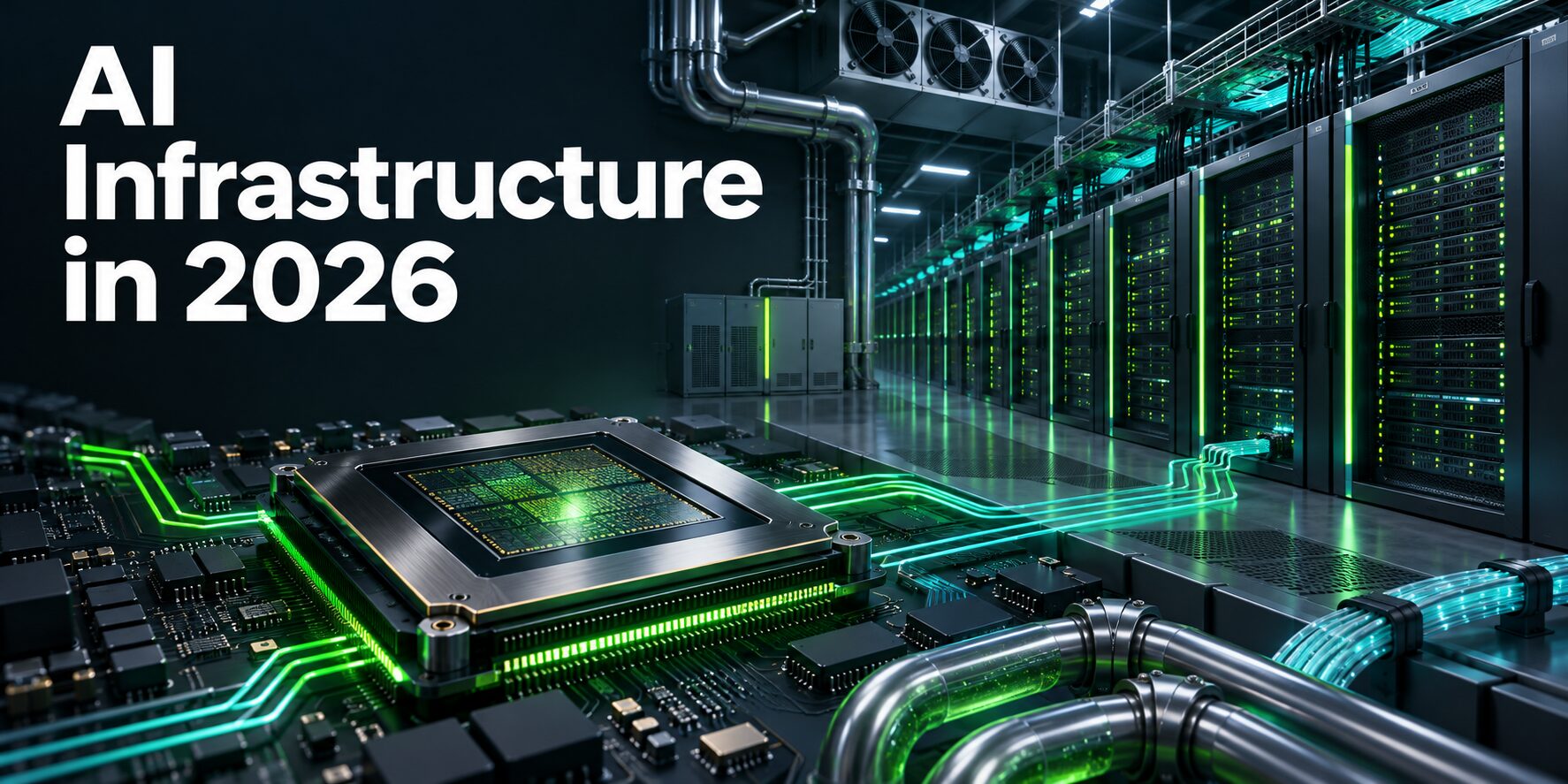
AI infrastructure in 2026 is the physical foundation of artificial intelligence, bringing together GPUs, high-speed networking, power, and cooling to train and run large models.By 2026, artificial intelligence has become less a software story and more an infrastructure story. Training and running large models now depends on a physical stack of GPUs, high-speed networking, power, and cooling that has turned data center construction into one of the largest capital investment categories in the world. This article examines what is actually powering the current AI buildout: NVIDIA’s expanding role across silicon, networking, and software; the rise of GPU cloud providers, often called neoclouds, that compete alongside traditional hyperscalers; and the emerging power and energy constraints that are now shaping where and how quickly this infrastructure can be built. It closes with practical context for anyone trying to understand where this market is heading.
To understand why this physical stack matters, it helps to first understand how artificial intelligence works through the combination of data, algorithms, and computation.
Why Infrastructure Became the Story
For most of the last decade, progress in artificial intelligence was framed primarily as a research problem: better architectures, larger datasets, smarter training techniques. That framing has shifted considerably. Model capability today is tightly coupled to the amount of compute an organization can access, and compute at this scale is not something that can be assembled quickly. It requires GPUs, specialized networking to connect thousands of them together, enormous amounts of electrical power, and cooling systems capable of handling the heat that dense GPU clusters generate.
This is why phrases like “AI factory” have entered common use among infrastructure providers. NVIDIA has been working with the U.S. Department of Energy’s national labs and leading companies to build AI infrastructure meant to support scientific discovery and economic growth, language that treats compute capacity itself as a form of industrial output. The scale involved is difficult to overstate. One system alone, Equinox, is expected to include 10,000 NVIDIA Blackwell GPUs when it becomes available in 2026, interconnected with a companion system to deliver a combined 2,200 exaflops of AI performance.
The commercial stakes have grown accordingly. OpenAI and NVIDIA announced a strategic partnership to deploy at least 10 gigawatts of NVIDIA systems for OpenAI’s next-generation AI infrastructure, with the first phase expected online in the second half of 2026 using NVIDIA’s Vera Rubin CPU and GPU platform. Ten gigawatts is roughly comparable to the output of several large nuclear power plants, dedicated to a single company’s compute needs. That figure alone explains why infrastructure, rather than algorithms, now dominates conversations about the pace of AI progress.
NVIDIA's Expanding Role Across the Stack
NVIDIA remains the center of gravity in this buildout, but its role has broadened well beyond selling chips. The company now positions itself as a full-stack infrastructure provider, spanning GPUs, CPUs, networking, storage, and software.
The current generation of products reflects this expansion. Alongside the Blackwell architecture, which has become the standard high-performance option deployed across major clouds, NVIDIA has introduced the Vera Rubin platform, pairing next-generation GPUs with NVIDIA’s own Vera CPUs rather than relying solely on third-party processors. Cloud providers like Nebius are deploying multiple generations of NVIDIA infrastructure, including early adoption of the Rubin platform, Vera CPUs, and BlueField storage systems, alongside NVIDIA’s GPU health monitoring tools for fleet management. NVIDIA CEO Jensen Huang has framed this moment as a distinct inflection point, noting that agentic AI is driving incredible compute demand and accelerating infrastructure buildout across the industry.
Cloud partnerships have deepened alongside the hardware itself. At NVIDIA’s GTC conference in March 2026, both AWS and Google Cloud detailed major infrastructure expansions built around NVIDIA hardware. AWS announced plans to deploy more than one million NVIDIA GPUs across its regions starting in 2026, including Blackwell and Rubin architectures, along with support for NVIDIA’s Inference Xfer Library to accelerate large language model inference. Google Cloud, meanwhile, plans to be among the first providers offering NVIDIA Vera Rubin NVL72 rack scale systems in the second half of 2026 as part of its AI Hypercomputer architecture. Google has also introduced more flexible consumption options, including fractional GPU virtual machines using NVIDIA vGPU technology, allowing customers to right-size infrastructure for workloads ranging from spatial computing to model fine-tuning and inference on models between 30 billion and more than 100 billion parameters.
NVIDIA’s reach now extends beyond the largest hyperscalers as well. The company has struck partnerships with smaller, regionally focused cloud providers to widen distribution of its hardware. A new partnership with Australian AI cloud company Firmus Technologies will see Firmus purchase NVIDIA hardware and offer NVIDIA powered cloud services to startups and smaller AI focused companies, with NVIDIA benefiting from both hardware sales and a share of resulting cloud service revenue. Deals like this illustrate a broader pattern: NVIDIA is no longer simply a component supplier. It is actively shaping how compute capacity reaches the market, often taking a financial stake in the outcome.
The Rise of the Neocloud
Alongside the traditional hyperscalers, a distinct category of infrastructure provider has grown rapidly over the past two years. Often called neoclouds, these are companies built specifically around dense GPU fleets rather than general purpose cloud computing. CoreWeave, Nebius, Lambda, and Crusoe are among the most recognized names in this category.
The business model differs meaningfully from traditional cloud computing. Rather than offering broad, general purpose services, neoclouds focus narrowly on delivering bare metal or near bare metal GPU access for training and inference. Building a data center typically takes eighteen to thirty months, but a neocloud can often lease existing space, rack servers, and bring capacity online in a matter of weeks, giving them a speed advantage over traditional infrastructure buildouts. Many neoclouds also rely on a distinctive financing approach, combining conventional equity with debt secured against the GPUs themselves. Contract-based providers like CoreWeave typically lock in multi-year deals at fixed rates, where customers commit to a fixed number of GPU hours for two to five years and pay regardless of actual usage, while on-demand providers like Lambda adjust pricing based on real-time demand.
The scale some of these companies have reached is substantial. CoreWeave raised the low end of its projected 2026 capital expenditure range to as much as $35 billion, citing persistent infrastructure component inflation tied to AI demand, and disclosed a new $21 billion commitment with Meta tied to long term AI deployments. Nebius has posted similarly steep growth from a smaller base. The company’s first quarter revenue climbed 684 percent year over year to $399 million, while its AI-specific revenue surged 841 percent to $390 million, with adjusted earnings swinging to a $129.5 million profit from a loss the year before.
Much of this growth is tied to relationships with the largest AI labs and hyperscalers rather than direct retail customers. In many cases, end users renting compute through a major cloud provider are not even aware their workload has been routed to a neocloud’s data center behind the scenes, a pattern that has made these partnerships lucrative even as neoclouds work to build their own direct customer bases.
Power Has Become the Real Constraint
For much of the last several years, the primary bottleneck in AI infrastructure was GPU supply itself. That has shifted. Industry analysts increasingly describe power availability, not chip availability, as the defining constraint on how quickly new AI capacity can come online. Research from infrastructure analysts has concluded that GPU availability alone is no longer the defining constraint, and that power procurement, cooling readiness, and deployment velocity now determine how quickly AI infrastructure becomes productive capacity.
This shows up clearly in how the largest providers describe their own expansion targets. CoreWeave is targeting 1.7 gigawatts of active power by the end of 2026, while Nebius is targeting between 800 megawatts and 1 gigawatt of connected power, with both companies working to convert already contracted power into active, usable capacity. Notably, CoreWeave and Nebius have each secured 3.5 gigawatts of contracted power capacity, though the vast majority of that contracted capacity has yet to actually come online, underscoring how far ahead power agreements tend to run relative to physical build-out.
The scale of energy demand tied to AI is projected to grow substantially through the rest of the decade. Research from Uptime Institute Intelligence projects that energy consumption from AI training and inference in data centers will grow from roughly 131 terawatt hours in 2026 to approximately 250 terawatt hours by 2030. That near doubling in under five years explains why some infrastructure providers have started competing less on chip access and more on energy strategy. One provider, Crusoe, built its early business around turning stranded and flared natural gas into usable compute power, positioning energy access itself as its main competitive differentiator in an increasingly power-constrained market.
This power constraint is also reshaping where new infrastructure gets built. Regions with available grid capacity, favorable energy pricing, or access to alternative power sources have become disproportionately attractive for new data center construction, sometimes outweighing traditional considerations like proximity to major population centers or existing network infrastructure.
What This Means Going Forward
Several trends are worth watching as this buildout continues. First, the shift from training focused infrastructure toward infrastructure optimized for sustained inference is accelerating, as AI applications move from research and experimentation into continuous production use. This changes the underlying hardware and facility requirements, since inference workloads tend to demand different latency and uptime characteristics than large batch training runs. The rise of reasoning models adds another consideration: multi-step reasoning can increase the compute required to produce an answer. Where inference happens also matters: Edge AI runs models on devices or local systems, changing latency, connectivity, and hardware requirements.
Second, the financial structure underlying much of this buildout deserves scrutiny. A significant share of neocloud growth has been financed through debt secured against GPU hardware, an approach that assumes sustained demand and stable GPU valuations over the life of the loan. Should demand growth slow or GPU depreciation accelerate faster than expected, this financing structure could face real pressure. Analysts have already begun describing circular financing patterns among NVIDIA, its cloud partners, and the largest AI labs, where investment, hardware sales, and cloud revenue increasingly flow between the same small set of companies.
Third, regional and sovereign AI infrastructure is expanding as a category of its own, separate from the largest American hyperscalers. Projects aimed at building dedicated AI capacity within specific countries or regions, often with direct government or NVIDIA backing, reflect a growing view that AI compute capacity is now a matter of national economic and strategic interest, not simply a commercial product.
Conclusion
The AI infrastructure landscape in 2026 looks meaningfully different from where it stood even two years earlier. NVIDIA has expanded well past its role as a chip supplier into a broader infrastructure partner spanning silicon, networking, and cloud relationships. A new category of GPU focused cloud providers has grown rapidly alongside traditional hyperscalers, financed through an increasingly complex mix of equity and hardware backed debt. And the primary constraint on growth has shifted from chip supply toward power availability, cooling capacity, and the physical speed of construction. Understanding these dynamics matters for anyone trying to assess where AI capability is actually headed, since the pace of progress now depends as much on gigawatts and data center construction timelines as it does on research breakthroughs.
Frequently Asked Questions
1. What exactly is a neocloud, and how is it different from a traditional cloud provider like AWS or Google Cloud?
Answer: A neocloud is a cloud provider built specifically around dense GPU infrastructure for AI training and inference, rather than general-purpose computing services. Companies like CoreWeave, Nebius, and Lambda focus narrowly on delivering GPU capacity quickly, often financed through debt secured against the hardware itself, and frequently serve as capacity partners to larger hyperscalers rather than competing with them directly for retail customers.
2. Why has power become a bigger constraint than GPU supply?
Answer: GPU manufacturing has scaled considerably, but electrical power infrastructure takes years to build and cannot be expanded as quickly. Data centers now require gigawatt scale power commitments, and most providers have secured far more contracted power than they have actually connected and brought online, making power delivery, rather than chip availability, the primary bottleneck on new capacity.
3. What is NVIDIA's Vera Rubin platform, and why does it matter?
Answer: Vera Rubin is NVIDIA’s next generation platform pairing new GPU architectures with NVIDIA’s own Vera CPUs, moving away from reliance on third-party processors. Major cloud providers, including Google Cloud, plan to offer Vera Rubin based systems in the second half of 2026, and it represents NVIDIA’s continued push to control more of the full computing stack rather than just the GPU component.
4. Is the current AI infrastructure spending sustainable?
Answer: This remains genuinely debated among analysts. Spending levels are extremely high, and a meaningful portion of neocloud growth is financed through debt secured against GPU hardware, which assumes continued strong demand and stable equipment valuations. Some analysts have raised concerns about circular financing patterns between chip suppliers, cloud providers, and AI labs, though demand from major AI labs has so far continued to support this level of investment.
5. How long does it typically take to bring new AI data center capacity online?
Answer: Traditional data center construction generally takes eighteen to thirty months from start to finish. Neoclouds have differentiated themselves partly by compressing this timeline, often leasing existing space and racking servers to bring capacity online within weeks, though this approach still depends heavily on power availability and equipment delivery timelines that neither approach can fully control.