

Table of Contents
Imagine starting your workday and discovering that a new AI tool can complete a task that previously took several hours. Your first thought might be, “Will this make my job easier, or will it eventually replace what I do?”
From software development to marketing and cybersecurity, technology is changing how people work. But learning every new tool is not the answer. A more useful question is, “How can I adjust my skills and working methods when the tools around me change?”
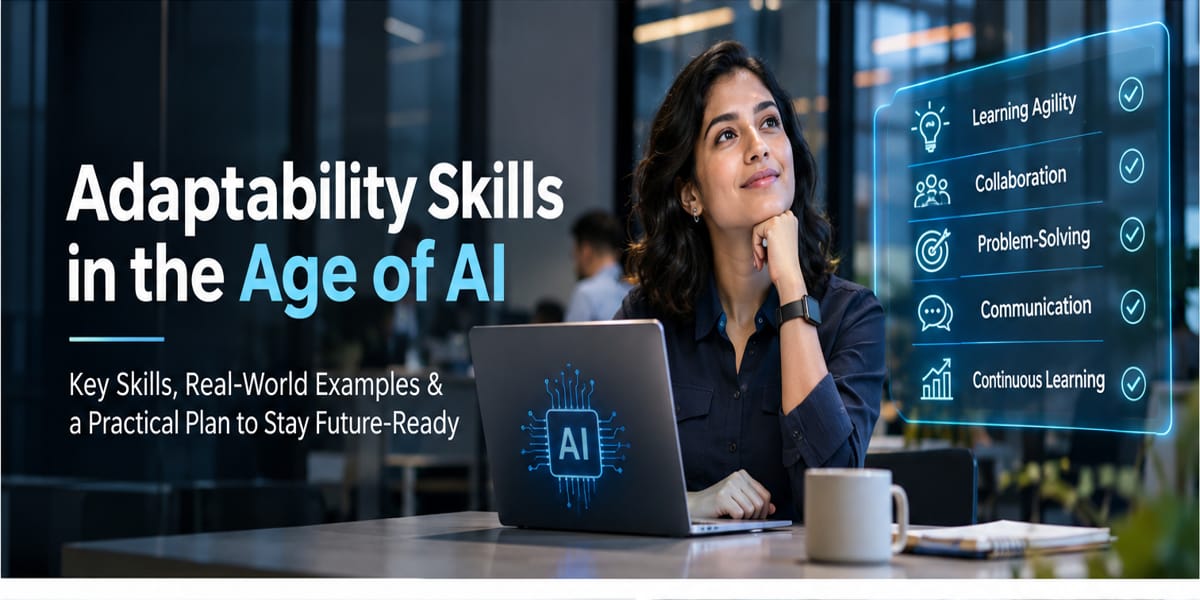
That is where adaptability skills become valuable. Adaptability means responding effectively to new situations by adjusting how you think, learn, communicate, and solve problems. It also means knowing when to use AI, when to question its output, and when human judgment matters most.
Developing adaptability in the age of AI does not mean predicting every technological change. It means building the ability to respond thoughtfully when change happens. This guide covers practical examples, common barriers, and exercises you can use at work.
What Are Adaptability Skills?
Adaptability skills are the abilities that help you adjust your thinking, behavior, and working methods when circumstances change. They include learning unfamiliar processes, solving unexpected problems, communicating with others, and responding constructively to feedback.
Imagine your company replaces its project management system. An adaptable employee does not simply memorize the new interface. They identify changed workflows, learn relevant features, ask questions, and adjust their daily routine.
Adaptability is a collection of related soft skills, not a single personality trait. It can involve cognitive adaptability (changing your approach to a problem), emotional adaptability (managing uncertainty), and interpersonal adaptability (adjusting how you work with others).
Adaptability vs. Flexibility vs. Resilience
Skill | Meaning | Workplace example |
Adaptability | Adjusting methods when conditions change | Learning a new workflow |
Flexibility | Willingness to change arrangements | Reordering tasks when priorities shift |
Resilience | Recovering after setbacks | Regrouping after an unsuccessful project |
A person may be flexible about deadlines but reluctant to learn a new system. Another may recover quickly from setbacks but resist changing established methods. These capabilities overlap, yet they answer different challenges.
The Importance of Adaptability Skills in the AI Workplace
Why does adaptability matter? Job requirements evolve, organizations revise processes, and AI changes how certain tasks are performed. Workers need to learn new methods while maintaining quality and accountability.
The World Economic Forum Future of Jobs Report 2025 identifies resilience, flexibility, and agility among the core skills reported by surveyed employers. Its findings describe employer expectations, not a guarantee that a particular employee will keep a job.
The ETS Human Progress Report 2026 describes workers trying to develop skills amid uncertainty about the future. Its survey findings can help explain why motivation alone is not enough: people also need clear priorities and opportunities to practice.
Why Adaptability Matters for Career Growth
Consider two employees introduced to an unfamiliar reporting system. One continues using the old process without checking whether it still meets requirements. The other tests the new system, identifies its limitations, and asks for feedback before adjusting their workflow.
The second employee demonstrates learning agility, critical thinking, and continuous learning. Such behaviors can help with changing responsibilities, but adaptability alone does not guarantee promotions, salary increases, or job security.
8 Essential Adaptability Skills Examples for Modern Professionals
The following eight categories are a practical editorial grouping, not a standardized psychological classification. Each becomes meaningful when you can describe an observable behavior.
Learning Agility and Continuous Learning
Learning agility means acquiring new knowledge and applying it to unfamiliar situations. A developer learning a testing framework can start with a small project, check results, and build confidence rather than attempting to master every feature at once.
Critical Thinking and Problem-Solving
Critical thinking means evaluating information before acting. If an AI assistant suggests a code change, a developer checks whether it addresses the original issue, introduces vulnerabilities, or breaks existing functionality.
Emotional Intelligence and Resilience
Workplace change can create uncertainty or frustration. Emotional intelligence helps people recognize their responses; resilience supports recovery after setbacks. Neither requires pretending every change is positive.
Communication Skills and Active Listening
When a team introduces automated reporting, employees need to clarify what changes and what still requires review. Asking “Which decisions still need manual approval?” can prevent avoidable mistakes.
Collaboration and Interpersonal Skills
A cybersecurity analyst introducing a scanning process may need to coordinate with developers. Collaboration requires understanding technical risks and delivery constraints, not just announcing a new rule.
Creative Thinking and Strategic Thinking
When an established campaign stops performing, a marketing team can review evidence, propose alternatives, and test a revised approach. Creative thinking generates options; strategic thinking considers consequences.
Growth Mindset and Openness to Feedback
When a manager says a report is unclear, an employee can ask what was missing, revise the format, and check whether the next version is easier to understand. This makes feedback actionable
AI Literacy and Organizational Skills
AI literacy includes understanding appropriate use and limitations of AI systems. Organizational skills help people manage responsibilities and checks. An employee can draft with an approved AI tool while verifying accuracy and protecting sensitive information.
Real-Life Examples of Adaptability in the Workplace
The following scenarios are illustrative, not verified case studies. They show how an employee might adapt when tools or expectations change.
Role | Change | Adaptive response |
Software developer | AI coding assistant introduced | Learn tool, review code, run tests |
Cybersecurity analyst | AI-assisted alert triage | Check supporting evidence and approved response procedures |
Marketing professional | AI-assisted drafting workflow | Verify claims and maintain editorial review |
Team manager | Automation changes task ownership | Clarify responsibilities and gather feedback |
The Difference Between Using AI and Adapting to AI
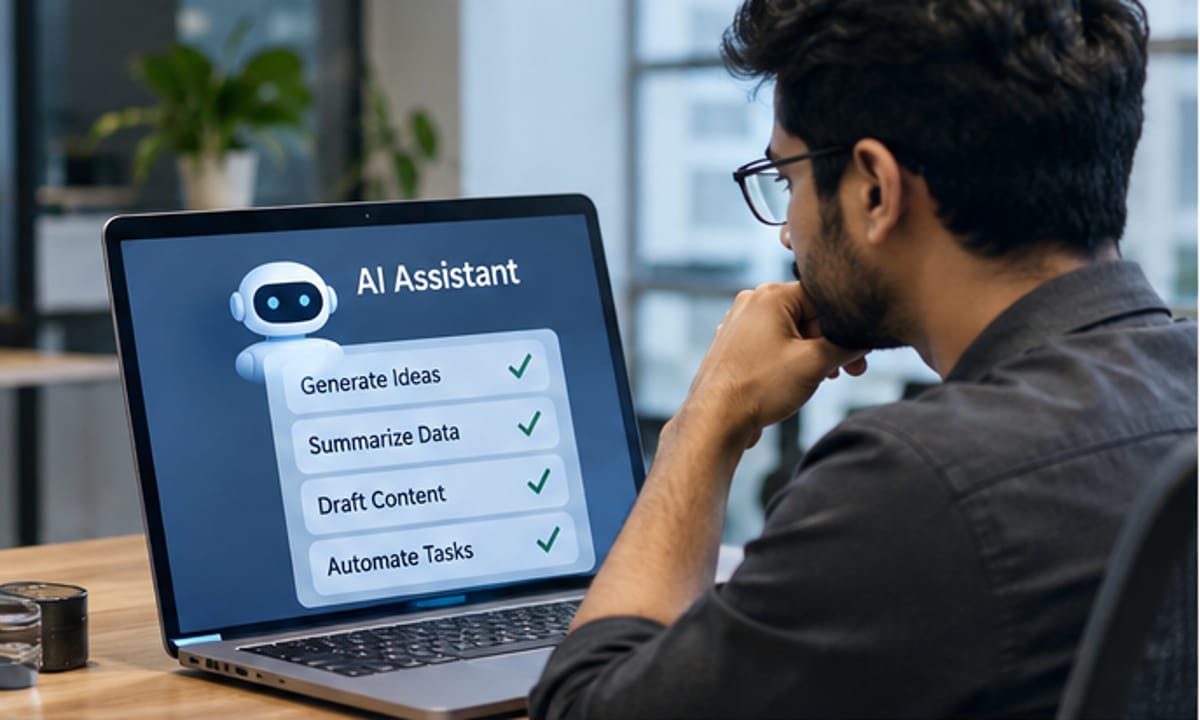 Suppose an AI system recommends isolating a device after an alert. Accepting the recommendation without review is tool use, not necessarily good judgment. An analyst who checks evidence, follows incident-response procedures, and selects an authorized action is adapting their process responsibly.
Human-AI collaboration can combine automation with context, verification, and accountability. The same principle applies when developers review generated code or marketers check AI-produced claims.
How to Improve Adaptability Skills at Work
Step 1: Identify What Is Changing
Ask: What changed? Which tasks are affected? What do I need to know? Separating confirmed changes from assumptions helps prevent unnecessary reactions.
Step 2: Learn One Relevant Skill
Choose a skill linked to a real task. If your team adopts an AI-assisted reporting process, focus on checking its outputs before exploring unrelated features.
Step 3: Experiment in a Low-Risk Environment
Use approved tools and non-sensitive sample data. Compare a manually prepared report with an AI-assisted draft and inspect differences in accuracy, completeness, and clarity.
Step 4: Request Constructive Feedback
Ask a colleague or manager, “What is one thing I could improve about this approach?” Specific feedback can reveal problems you may not notice yourself.
Step 5: Reflect and Adjust
Record what worked, what failed, and what you would do differently next time. Repeat the cycle: learn, apply, verify, improve.
A Practical 30-Day Adaptability Development Plan
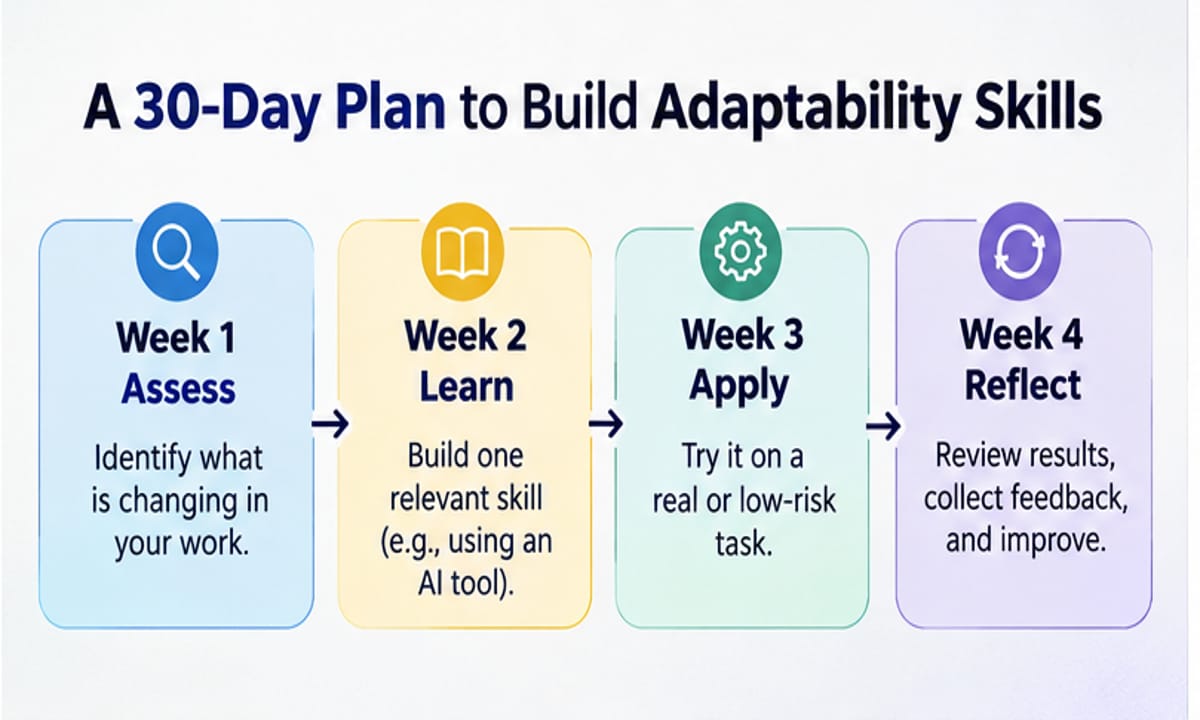 This is a suggested four-week practice routine, not a scientifically validated 30-day intervention.
Week | Focus | Practice |
1 | Awareness | Identify one task affected by changing tools or expectations |
2 | Learning | Learn one relevant method using approved resources |
3 | Application | Test it on a low-risk task and request feedback |
4 | Reflection | Review what changed and identify the next improvement |
How to Assess Your Adaptability Skills
Instead of judging adaptability only by how comfortable you feel, examine what you do when circumstances shift. Use these questions for reflection, not as a validated diagnostic test.
- Can I explain what changed before deciding how to respond?
- Will I learn an unfamiliar process when work requires it?
- Do I seek clarification and feedback rather than relying on assumptions?
- Can I revise my approach when evidence contradicts it?
- Do I verify unfamiliar technology outputs before relying on them?
Write down specific examples, such as learning a system, revising a workflow, or responding to feedback. These behavioral indicators are more useful than simply declaring, “I am adaptable.”
Common Barriers to Adaptability in the Workplace
Barrier | What it looks like | Practical response |
Fear of change | Avoiding unfamiliar tasks | Break change into smaller actions |
Information overload | Trying to learn every tool | Choose one job-relevant priority |
Low confidence | Hesitating after setbacks | Practice in low-risk settings |
Resistance to feedback | Treating critique as a personal attack | Ask for one specific improvement |
Overdependence on AI | Accepting outputs without review | Build verification into workflow |
Change management also depends on organizational support. Managers can help by explaining expectations, allocating learning time, and encouraging questions. Employees cannot solve unclear leadership decisions through individual adaptability alone.
How to Demonstrate Adaptability Skills at Work
Explain the change, your response, and the result. For example: “When our team introduced a reporting system, I learned its key features, tested the revised workflow, and worked with colleagues to resolve formatting issues.” This is an illustrative response, not an employee testimonial.
Use genuine outcomes when describing your own work. Add percentages or time savings only if you have measured evidence.
Conclusion: Building Adaptability Skills for the Future
You cannot predict every new tool or responsibility, but you can improve how you respond. Adaptability skills involve learning unfamiliar methods, evaluating information, collaborating with others, and adjusting when circumstances demand it.
Adaptability in the age of AI is not blind enthusiasm for automation. It is a deliberate combination of learning, verification, and human judgment. Choose one work process this week, identify a small improvement, test it safely, and reflect on what you learned.
Frequently Asked Questions
What are adaptability skills in simple words?
They are abilities that help you adjust to new tasks, expectations, and challenges by learning, communicating, and changing your approach.
What are examples of adaptability skills?
Examples include critical thinking, communication, collaboration, resilience, learning agility, and openness to feedback.
Why do adaptability skills matter in the age of AI?
AI changes some tools and workflows. Adaptability helps employees learn new methods, evaluate outputs, and retain appropriate human oversight.
How can I improve adaptability skills at work?
Choose one unfamiliar task, practice a relevant method in a low-risk setting, ask for feedback, and reflect on the result.
What is the difference between adaptability and flexibility?
Flexibility means being willing to adjust arrangements. Adaptability includes changing how you think or work when conditions change.
Can adaptability skills be learned?
Related behaviors can be developed through practice, feedback, reflection, and exposure to unfamiliar situations.
How do you demonstrate adaptability in an interview?
Describe a real change, the actions you took, and the result. Avoid unsupported claims and use genuine outcomes.
World Economic Forum, Future of Jobs Report 2025: https://www.weforum.org/publications/the-future-of-jobs-report-2025/
ETS, Human Progress Report 2026: https://www.ets.org/newsroom/adaptability-revealed-as-new-foundation-of-job-security-in-ai-age-human-progress-report-finds.html
Editorial policy: verify original statistics, dates, methodology, and author credentials before publication. Blue prompts must be resolved or removed; grey notes must be applied and removed before publishing.