
Table of Contents
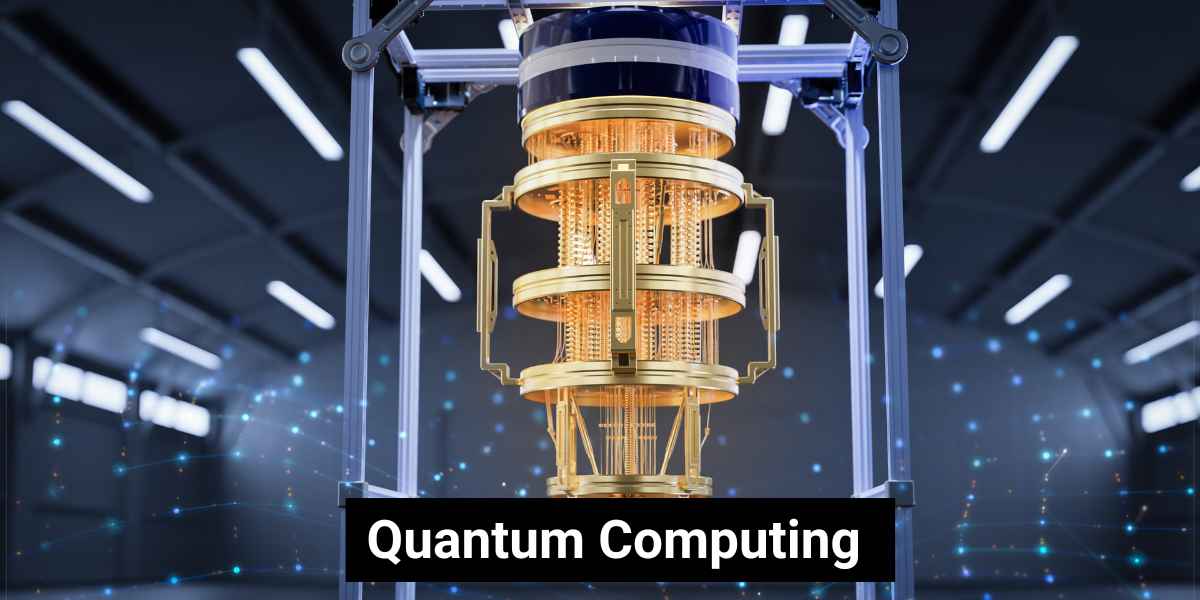
ToggleThe major distinguishing factor between the traditional computer and the Quantum Computing is the fact that the traditional computers work on classical logic, whereas the quantum computer works on quantum physics. The measuring unit of quantum computers is known as the qubit; a particle which behaves in ways that classical particles cannot. For example, qubits can be placed in a superposition state such that they are both in 0 and 1 states at once, qubits can become entangled with one another, and finally qubits can be interfered such that some solutions become more prevalent, while other become non-existent. It is for these reasons that quantum computers are said to be distinctly different from the classical computers.
However, despite the fact that it’s real, it’s relatively fresh, and current quantum computers are pretty rudimentary and unpredictable, which is precisely why researchers do their utmost to reduce errors, improve hardware, and make use of hybrid approaches. Some of the most well-known applications of quantum computers include breaking down particular types of public key encryption through Shor’s algorithm, searching for solutions faster than possible through classical computing using Grover’s algorithm, and simulating molecular behavior in areas where classical computers fall short.
More immediate applications include developments in the realm of quantum chemistry, improvements in quantum error correction, and particular niche uses such as quantum-certified randomness. Due to the more distant problem of vulnerability to cryptography, the first draft of post-quantum cryptography standards was just released by NIST, recommending organizations begin preparation.
Why quantum computing feels strange
A classical bit is simple: it is either 0 or 1. A qubit is a real physical object—such as a superconducting circuit, a trapped ion, or a photon—that can be controlled so it behaves like a quantum two-state system. The simplest plain-English analogy is this: a classical bit is like a coin lying flat on a table showing heads or tails, while a qubit is more like a coin spinning in midair. Before you look, the spinning coin is not secretly one or the other in the ordinary classical sense; it carries richer information about the chances of different outcomes.
That richer behavior is called superposition. A qubit can be prepared in a blend of 0 and 1, and the blend determines the probabilities you see when you measure it. But measurement is the catch: when you measure a qubit, you do not get “both answers.” You get one result, and the underlying quantum state is disturbed or destroyed in the process. That is why quantum programs are usually run many times to estimate probabilities.
When two or more qubits are linked so strongly that you must describe them as one combined system, they are entangled. A simple analogy is two perfectly choreographed dancers: you cannot fully describe one dancer’s move without also describing the other’s. Entanglement is one of the reasons quantum computers can represent correlations that are awkward for classical machines to store or update directly.
One common misunderstanding is that a quantum computer “tries every answer at once and then magically reads them all.” That is not how it works. Quantum states can spread across many possibilities, but measurement gives only one outcome. The trick is interference: clever sequences of gates amplify paths leading to good answers and suppress paths leading to bad ones. In plain English, a good quantum algorithm is less like brute-force guessing and more like arranging waves so the wrong guesses cancel while the right ones reinforce.
How a quantum computation unfolds
A quantum computation usually follows a simple logic: prepare qubits, apply gates, create useful patterns of superposition and entanglement, then measure and interpret the results. In hybrid algorithms, a classical optimizer may then update the settings and repeat the loop.
Quantum gates are the operations that move qubits around in their quantum state space. Single-qubit gates change one qubit at a time; multi-qubit gates can tie qubits together and create entanglement. A quantum circuit is simply a time-ordered recipe showing which gates are applied and when.
The hardest part is that quantum information is fragile. Decoherence is what happens when outside noise—heat, stray fields, imperfect control, or unwanted interaction with the environment—damages a superposition or entangled state. NIST describes decoherence as the destruction of a superposition by outside disturbance, including measurement itself.
That fragility is why quantum error correction matters. The basic idea is to encode one logical qubit across many physical qubits, then measure carefully chosen error syndromes indirectly so you learn about errors without simply reading out and destroying the encoded computation. IBM’s public explanations describe this as the quantum analogue of redundancy in classical error protection, but adapted to handle both bit-flip-like and phase-like errors. In common surface-code-style thinking, even one useful logical qubit can require hundreds of physical qubits, which is why fault-tolerant quantum computing remains such a big engineering challenge.
How the field got here
The modern idea of quantum computing grew out of the early 1980s, when pioneers including Benioff, Feynman, Bennett, and Deutsch argued that a machine obeying quantum mechanics could compute in ways classical machines could not. The field gained practical urgency in 1994, when Peter Shor showed that a quantum computer could factor large integers efficiently enough to threaten RSA-style public-key cryptography. Two years later, Lov Grover showed that quantum search could give a square-root speedup for unstructured search problems.
In plain English, Shor’s algorithm is the big cryptography headline. It turns a problem believed to be extremely hard for classical machines—factoring very large numbers—into one a sufficiently large, fault-tolerant quantum computer could do much more efficiently. That is why Shor matters so much for RSA and related systems. But there is an equally important practical point: the machines needed for Shor at useful cryptographic scale are far beyond today’s noisy devices.
Grover’s algorithm is more modest but still important. If you must search an unstructured set of possibilities, Grover can reduce the work from roughly N tries to roughly the square root of N. That is a real speedup, but it is not the world-changing exponential jump that Shor offers for factoring. In cryptography, Grover is one reason larger symmetric keys remain prudent.
Because today’s hardware is noisy, much current work centers on variational quantum algorithms. These are hybrid loops in which a parameterized quantum circuit produces a value, a classical optimizer updates the parameters, and the process repeats. Nature Reviews Physics describes them as a leading near-term strategy because they can adapt to limited qubit counts and shallow circuit depths. Two famous families are VQE, used for ground-state energy estimation in chemistry and materials, and QAOA, aimed at optimization-style problems. Their promise is real, but so are their limitations: noise, measurement cost, and difficult training landscapes.
What the hardware looks like today
There is no single winning hardware platform yet. Different approaches make different trade-offs, and the public metrics are not perfectly apples-to-apples because the platforms use different qubit types, gate definitions, and benchmarks. As of June 2026, leading public efforts include IBM, Google Quantum AI, Rigetti, and IQM in superconducting systems; Quantum and IonQ in trapped ions; Xanadu, PsiQuantum, and Photonic in photonics; and Microsoft, QuTech, and the University of Copenhagen/QDev in topological research.
The hardware comparison can be understood in normal text as follows:
Superconducting: Superconducting platforms use Superconducting circuit qubits, usually transmons. Their coherence profile is described as follows: Public IBM examples are in the rough range of hundreds of microseconds; IBM documentation shows sample Heron-family qubits with T1 around 125–182 µs and T2 around 80–204 µs. For gate quality, Public IBM Heron systems list median 2-qubit error about 1.18×10^-3 to 2.69×10^-3, corresponding to roughly 99.73–99.88% 2-qubit fidelity. In terms of scalability, Strong fit with chip fabrication and fast gates, but cryogenics, wiring, and error correction overhead are major scaling challenges. Typical use cases include General gate-model computing, fast experiments, error-correction milestones.
Trapped ions: Trapped ions platforms use Individual charged atoms held in electromagnetic traps. Their coherence profile is described as follows: Trapped-ion systems are famous for long coherence; review literature cites coherence times in excess of 10 minutes in some systems. For gate quality, Quantinuum publicly reports >99.99% single-qubit and >99.9% two-qubit fidelity on H2, with all-to-all connectivity. In terms of scalability, Excellent control and connectivity, but speed and control complexity remain scaling bottlenecks. Typical use cases include High-fidelity logic, logical-qubit demos, networking, precision experiments.
Photonics: Photonics platforms use Single photons or photonic encoded states. Their coherence profile is described as follows: Often not summarized by one T1/T2 number; public photonic roadmaps emphasize loss, source quality, and indistinguishability more than conventional coherence metrics. For gate quality, PsiQuantum publicly reports figures such as 99.22% two-qubit fusion fidelity, 99.72% chip-to-chip fidelity, and ~99.8% source purity for Omega components. In terms of scalability, Potentially strong for modular networking and semiconductor-style manufacturing, but loss, switching, and nondeterministic operations are still key hurdles. Typical use cases include Modular fault-tolerant architectures, sampling, networking, quantum communication.
Topological: Topological platforms use Majorana-based topological qubits in hybrid devices. Their coherence profile is described as follows: If the approach works, it aims for built-in protection from local noise; Microsoft recently reported a mean qubit lifetime of 20 seconds, with some instances up to one minute, on Majorana 2. For gate quality, No broadly accepted, mature public system-level gate-fidelity benchmark yet. In terms of scalability, Potentially very attractive if intrinsic protection proves real at scale, but the entire approach is still research-stage and some claims remain debated. Typical use cases include Long-term path toward fault-tolerant computing; today, mainly frontier research.
What quantum computers may and may not do
The most realistic near-term opportunities are not “solve everything faster.” They are narrower. Quantum chemistry and materials science remain among the most plausible long-term beneficiaries because quantum systems can represent other quantum systems more naturally. Public-facing work from IBM and Quantinuum also points to chemistry, materials, and specialized workflows as early commercial targets, while the strongest current public “real-world” showcase may be certified randomness, demonstrated by JPMorganChase and Quantinuum with a 56-qubit trapped-ion system.
At the same time, official reports are blunt about the limits. Existing quantum devices are noisy; loading classical data efficiently can be hard; measurement is expensive; and many hoped-for speedups in optimization or machine learning remain unproven in practice. The National Academies has emphasized that quantum computers are unlikely to replace ordinary computing and are more likely to become accelerators attached to conventional systems.
The societal implications are bigger than the hardware itself. First, there is cybersecurity: a future large fault-tolerant quantum computer could undermine today’s vulnerable public-key cryptography, which is why NIST has finalized initial post-quantum standards and urges migration planning now. Second, there is governance: OECD and UNESCO both stress responsible innovation, international coordination, accessibility, and equitable benefit-sharing rather than letting quantum capability concentrate only in a few countries or firms. Third, there is a simple but important ethics issue: hype. Overclaiming can distort investment, public trust, and policy.
Open questions remain. No one knows which hardware platform will dominate, how quickly error correction will become economical, or which practical applications will show durable advantage over the best classical methods. Topological quantum computing is especially important here: it is one of the most exciting ideas in the field, but it is also one of the least settled experimentally.
Conclusion
Quantum computing is not something magical nor mysterious; it is simply a new computing paradigm which exploits highly delicate quantum phenomena that could sometimes beat classical computing in specific circumstances. Quantum computing, in simple words, involves rich qubits for storing information, gates manipulating those bits, amplification of relevant pathways through interference, and obtaining results via measurements.
There have been enough developments within science and technology that one can take quantum computing seriously; however, there are also many limitations associated with quantum computing, and therefore, one needs to be careful. In other words, the truth regarding quantum computing is probably the most valuable: quantum computing is neither mythical nor miraculous.
Frequently Asked Questions
Q:1 Is a qubit just “both 0 and 1 at the same time”?
That phrase is a useful shortcut, but it is incomplete. A qubit can be in a superposition of 0 and 1, yet measurement gives one outcome according to the state’s amplitudes; the power comes from how amplitudes interfere during the computation, not from reading out every possibility at once.
Q:2 Will quantum computers replace my laptop or the cloud?
No. The mainstream view from authoritative reports is that quantum computers will be specialized machines used for specific tasks, most likely as accelerators working with classical systems.
Q:3 Can quantum computers break encryption today?
Not at the scale needed for modern public-key cryptography. But the long-term threat is serious enough that NIST has already standardized initial post-quantum algorithms and says organizations should start migrating.
Q:4 Why are quantum computers so hard to build?
Because qubits are fragile. Decoherence, imperfect gates, readout error, and the huge overhead of quantum error correction all make scaling difficult. In many architectures, one reliable logical qubit can require many physical qubits.
Q:5 Which approach is most likely to win: superconducting, ions, photonics, or topological?
Nobody knows yet. Superconducting systems lead in fast chip-style integration, trapped ions in coherence and fidelity, photonics in modular networking potential, and topological systems in the promise of built-in protection—if they work as hoped.