
Table of Contents
ToggleSummary
Early in the generative AI boom, the winning move seemed simple: find the perfect prompt. A clever instruction could make a model summarize faster, code more cleanly, or sound more persuasive. That skill still matters. But by 2026, the center of gravity has shifted.
The hardest part of building a reliable AI system is no longer writing one brilliant prompt. It’s designing the whole information environment around the model what it’s told, what it can retrieve, which tools it can use, what it remembers, how much gets compressed, what permissions it has, and what evidence it can point back to. That broader discipline is what people now call context engineering.
This shift didn’t happen because prompt engineering failed. It happened because AI products stopped being simple chat boxes. Vendors now talk about agents, long-running tasks, conversation state, retrieval, external tools, and multi-agent workflows. Guidance from major AI labs increasingly points to workflows, tools, and context management as the real design challenge not clever phrasing alone.
So the honest way to state it is this: context engineering isn’t killing prompt engineering, it’s absorbing it into something bigger. The prompt is now just one layer in a larger stack. The real craft is deciding what the model should know, when, how much of it, what to leave out, what it’s allowed to do, and how the whole setup gets evaluated over time.
What Is Context Engineering
To grasp the concept of context engineering, it is necessary to stop thinking about “the prompt” as a standalone text box and replace this view with the belief that the model’s response relies on the entire data set available to it, which is formed of the system instructions, previous conversations, long-term memory and any data collected from sources. The industry has made the shift from polishing a single prompt to creating the system, which will construct the data in the right format at the right time.
This new understanding of the nature of context engineering has changed the way we perceive the process of accomplishing the task successfully. If working in line with the principles of prompt engineering meant playing with the phrases in order to get the model to take on specific roles, give examples, and look at the problem from several perspectives, then in terms of context engineering, success becomes a complex, multi-step process, which includes crucial information selection, document retrieval, selection of the relevant tools, information compression, storage of needed memories along with controlling the flow of irrelevant and hazardous information.
Researchers have started formalizing this. Recent surveys describe context engineering as going beyond prompt design into context retrieval, processing, and management spanning retrieval-augmented generation, memory systems, tool-integrated reasoning, and multi-agent systems. The underlying message isn’t mystical: better output usually comes from better context packaging, and by 2026 the term has moved from a niche framing into a practical, everyday concept for anyone shipping production AI assistants.
Context Engineering vs Prompt Engineering
Prompt engineering and context engineering solve problems of very different sizes. Prompt engineering focuses on the instruction itself how you phrase a task, how much detail to add, whether to include examples, which format to demand, and how to steer the model’s behaviour. That work still matters, especially for isolated tasks, templates, and user-facing interactions.
Context engineering starts where prompt engineering runs out of room. It asks: What corpus should be searchable? Which chunking strategy retrieves the right evidence? Should the model see full history or a summary? Which preferences deserve long-term memory? Which tools are safe and useful? When should the system compress prior turns? These aren’t wording questions they’re architectural ones.
A useful analogy: if prompt engineering is writing a strong brief for one meeting, context engineering is building the operating system for a whole team. Just as software performance depends on what’s loaded into memory, AI performance depends on what’s loaded into the model’s context window. Too little information and the model guesses; too much and the signal gets diluted, costs rise, and important instructions get buried.
The cleanest framing for 2026: prompt engineering is local optimization; context engineering is system design. A good prompt improves a single call. Good context engineering improves an entire workflow, repeatedly, across sessions and users. That difference becomes decisive once a system must act across multiple turns, consult files, call APIs, remember preferences, or coordinate with other agents. Prompting still matters it’s just no longer the main bottleneck.
Why Context Engineering Matters in 2026
The biggest driver is the rise of agent’s systems where the model dynamically directs its own process and tool use, rather than following a fixed script. The moment a model acts over time instead of answering once, context becomes a moving target. The system must decide what from the past still matters, what new data to fetch, what to preserve, and what to drop so the next step stays coherent.
A second driver is interoperability. As AI systems connect to real software file systems, calendars, internal tools, other agent’s context stops being a nice-to-have and becomes infrastructure. Standardized protocols for connecting models to data sources and tools now exist precisely because ad-hoc, one-off integrations don’t scale.
A third driver is economics. Sending everything to the model, every time, isn’t a strategy it’s a bill. More context means more tokens, more latency, and a more diluted signal. Systems that trim and compress context intelligently have shown dramatically lower latency and cost compared with “just include everything” approaches, without losing quality.
A fourth driver is reliability. Retrieval-augmented generation pairs a model’s built-in knowledge with explicit external evidence, improving factual accuracy and traceability. When a model needs to answer something about a policy, a calendar slot, or a compliance rule, giving it the right evidence or tool at the right step beats simply “asking it harder.”
The Building Blocks of Context Engineering
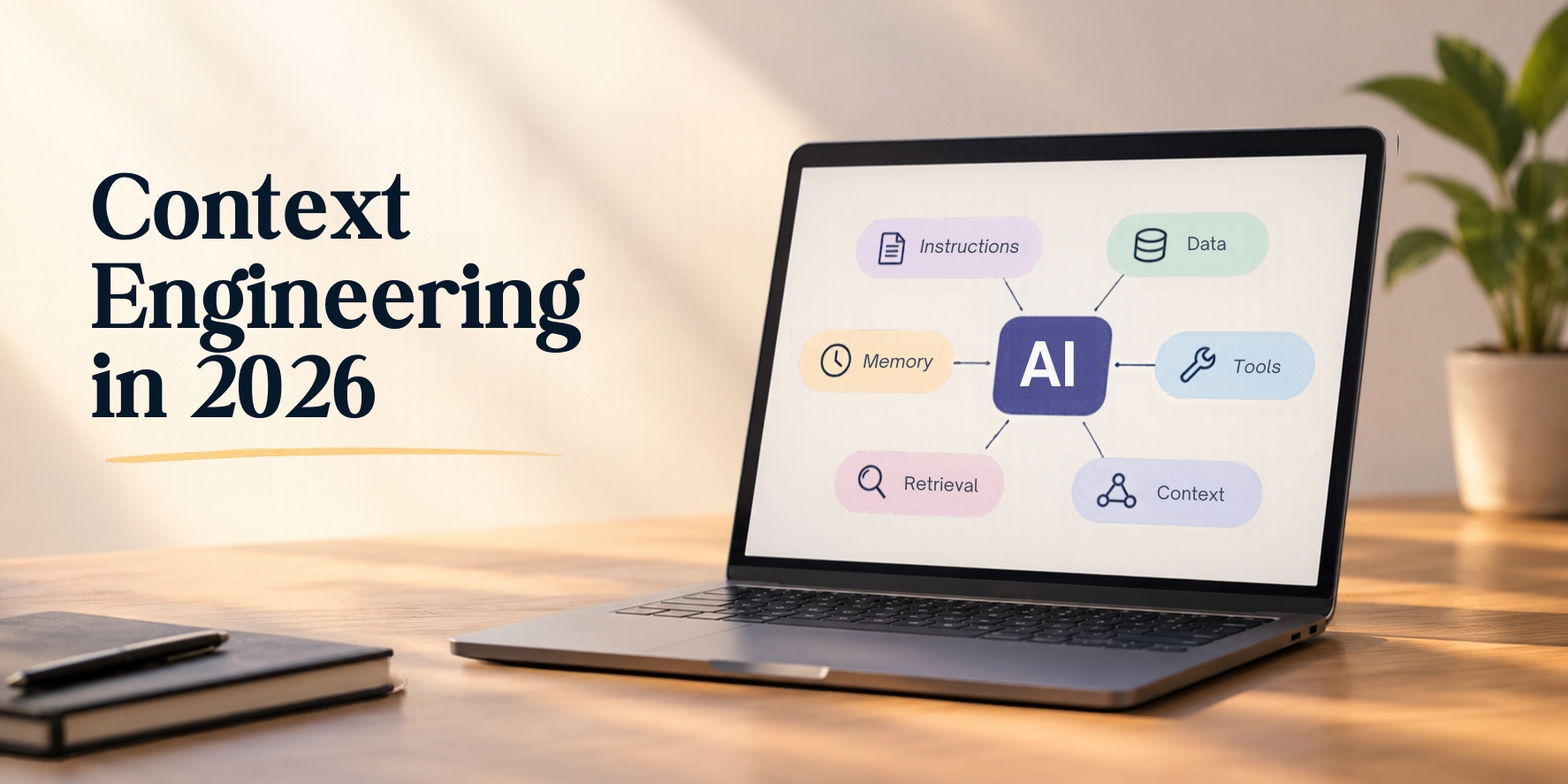
Instructions — system prompts, role definitions, examples, output schemas, policy constraints. These still matter, but work best paired with other forms of context rather than carrying the whole task alone.
Knowledge retrieval — the retrieval-augmented layer: file search, document lookup, web search, database queries, API-backed evidence. This gives models access to explicit, updatable memory instead of relying only on what’s baked into their weights, meaning fewer hallucinations and more current, traceable answers.
Memory — short-term memory (recent turns, scratchpads, tool outputs) and long-term memory (user preferences, recurring facts, durable summaries). Persistent systems need both continuity and selective forgetting; a model that remembers the wrong things is nearly as unreliable as one that remembers nothing.
Tools and action surfaces — tool descriptions, permissions, outputs, and error messages all shape what the model does next. Context engineering includes deciding which tools are available, what each one does, whether approval is required, and how outputs are represented.
Compression and selection — not everything deserves a permanent seat in the context window. Good practice means writing, selecting, compressing, and isolating information: deciding what matters, what should become a summary, and what should stay structured rather than dumped raw.
Isolation and safety — the moment models can browse, fetch files, or act across systems, the attack surface widens. Prompt injection becomes a real risk once models can reach connectors with access to sensitive data or the ability to take action. Context engineering is as much about keeping the wrong or malicious information out as it is about feeding the model more.
How to Practice Context Engineering
Start with a humble question: what does the model actually need to succeed at this task? Not what would be nice, not everything available only what’s necessary for the next step. Many context failures come from overfeeding models with noisy instructions, bloated history, poorly ranked retrieval, or too many vaguely described tools. Better context often means less context, chosen more carefully.
Treat context as a pipeline, not a paragraph. For each task, decide the order of operations: what should be known at the outset, what gets retrieved only once the goal is clear, what belongs in memory versus retrieval, what should be a tight summary instead of a raw log. Once these decisions are written down explicitly, teams move from prompt tinkering into real context engineering.
Instrument the system. If you can’t inspect what context was assembled behind a bad answer, you can’t improve it systematically. Production teams need logs, traces, retrieval diagnostics, tool-call audits, memory inspection, and regression tests. The model’s output is the last mile; the real engineering happens upstream.
Think in user stories, not abstractions. For an executive assistant, the harder questions aren’t about wording they’re about calendar access, contact-graph awareness, which tools need approval before acting, and what preferences the system should remember. The “magic” in a good AI product usually lives in that surrounding context, not in the model itself.
Finally, treat context engineering as a cross-functional skill sitting at the intersection of product sense, information architecture, prompt design, data retrieval, backend engineering, security, and evaluation. That breadth is a big part of why it’s overtaking prompt engineering as the prestige skill of 2026.
Best Practices and Common Mistakes
Favor relevance over volume. Context windows are limited working memory, not infinite storage. The job is to preserve what’s needed for the next step, not everything available. Stuffing the window is easy; curating it is the skill.
Separate static from dynamic context. Static context includes stable instructions, policies, and tool descriptions. Dynamic context includes retrieval results, recent dialogue, and current state. Brittle systems often fail because they blur the two burying hard rules in temporary memory, or treating shifting facts as permanent instructions.
Make provenance visible. Grounding answers in explicit sources makes debugging easier. If an answer is wrong, was it bad retrieval, a distorted summary, a malformed tool output, or a mis-scoped instruction? Without provenance, every failure just looks like “the model messed up.”
Don’t ignore security while expanding capability. The more connected an agent becomes, the more carefully its context boundaries need to be drawn. A good context engineer is part librarian, part architect, and part security engineer.
Don’t assume better models remove the need for good context. Usually the opposite is true — stronger models get pushed into longer, more autonomous workflows, which raises the stakes on context design rather than lowering them.
So, is context engineering really replacing prompt engineering? Narrowly, no people will keep writing prompts and refining templates. But in the professional sense that matters most in 2026, yes: the higher-value skill has shifted from “how do I ask nicely” to “how do I build a system that continually supplies the right knowledge, memory, permissions, tools, and constraints so the model works reliably over time.” That job now belongs to context engineering.
Conclusion
This isn’t really a story about one skill losing to another it’s about the field maturing. Prompt engineering mattered because the prompt used to be almost the whole system. Once AI products started acting like real systems, with memory, tools, retrieval, and multi-step reasoning, one text box could no longer carry the weight alone. Context engineering is simply the name for what took its place.
None of this makes the earlier skill worthless good phrasing, clean examples, and clear output formats still matter inside the bigger discipline. It just isn’t the whole job anymore. The practical takeaway: stop asking only “what should I type into the model,” and start asking “what does the model need around it to actually succeed.” That shift in framing is most of what it means to think like a context engineer.
FAQs
What is context engineering in simple terms?
It’s the practice of designing everything an AI model sees and can use before it responds: instructions, examples, retrieved documents, memory, tool access, output formats, and conversation state not just a single prompt.
Is prompt engineering dead in 2026?
No. It still matters for single-turn tasks, templates, and user-facing interactions. What’s changed is that production systems now depend heavily on retrieval, compaction, connectors, and tool orchestration, making context engineering the broader, more strategic skill.
Why are AI agents making context engineering more important?
Because agents don’t just answer once they operate across multiple steps, use tools, consult external systems, and carry state forward. That means constantly deciding what to remember, retrieve, summarize, and permit, which are context problems, not wording problems.
What are the core parts of a good context engineering setup?
Clear instructions, high-quality retrieval, short- and long-term memory, well-scoped tools, selective compression, provenance, and security controls.
How can someone start learning context engineering today?
Build one small AI workflow and trace exactly what context it uses at each step. Instrument retrieval, inspect memory, test compaction, restrict tools, and diagnose failures by asking whether the problem came from context that was missing, noisy, stale, or unsafe.